The en dash is used inconsistently within lots of writing – regardless of how ‘professional’ the writers are.
The hyphen, em dash and en dash are everywhere, but most of us don’t know when or why to use them – and different writers use the dashes in different ways. Let’s figure this out!
What do they look like?
| – | hyphen |
| – | en dash (or ndash, en-dash or n-dash) |
| — | em dash (or mdash, em-dash or m-dash) |
Do the first two look the same to you? It’s because some devices display them inconsistently, when the characters sit all by themselves. On a phone, the examples above may look wrong. However, they will probably look different in the next example, with some words or numbers adjacent to them.
Let’s look at those dashes with some text:
| twenty-five | hyphen |
| 11–25 |
en-dash |
| Well—yes. |
em-dash |
Let’s make that even more clear.
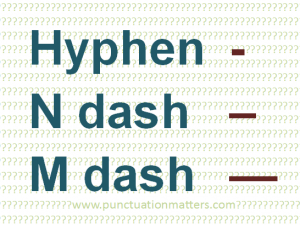
(This image was made with PowerPoint and Photoshop; the relative sizes of the dashes look right, however, the en dash and em dash don’t exactly match the width of the upper-case N and M – and they rarely do! It also depends on fonts, software and devices.)
When should I use a hyphen, en dash or em dash?
Hyphen
- Indicates breaks within words that wrap at the end of a line
- Connects compounded words like “mass-produced” (Closed compound words like counterintuitive have no hyphen in modern English, except for uncommon combinations that are confusing or ambiguous without a hyphen.)
- Connects grouped numbers, like a phone number 555-860-5086
- The hyphen does not indicate a range of numbers, like a date range, which is the job of an en dash
En dash
- Joins numbers in a range, such as “1993–99” or “1200–1400 B.C.” or “pages 32–37” or open-ended ranges, like “1934–”
- Joins words that describe a range, like “July–October 2010”
- There’s a lot more you can do with the en dash – read more below under “break the rules”.
Em dash
- Works better than commas to set apart a unique idea from the main clause of a sentence:
“Sometimes writing for money—rather than for art or pleasure—is really quite enjoyable.”
- Separates an inserted thought or clause from the main clause, such as:
“I can’t believe how pedantic Ken is about writing—doesn’t he have anything better to do?”
“Hunter strode into the room—was he mad?—and the family stopped and stared.”
“Computers make everyday punctuation—for reasons that we’ll discuss later—more precise yet more confusing.”
- Shows when dialogue has been interrupted:
“I reached in and pulled the spray can out of my backpack—” “In front of the police?”
Extra:
Here’s another obscure, old-fashioned use for the m-dash: When letters are uncertain or missing from a word that you are quoting or reporting about, you insert two m-dashes where the unknown letters would be. For example:
“Using dashes is a bit of an ad——n [addiction?]”, said Jennifer.
Break the rules!
If you are writing formal documents or writing for publication, it’s best to use dashes correctly.
However… Some people prefer the way a “space-en-dash-space” looks. Sometimes when you use the em-dash, people say, “What is that? I don’t like that big long thing.” I’ve heard that from colleagues and managers. That’s okay – we can find a very good compromise.
Some well-trained technical writers think the n-dash is the only one to use.
Choosing between the en dash or em dash is not a big deal. In my writing (as a manager corresponding with government officials and politicians, and also as a marketer communicating with real people) I use ‘space-n-dash-space’ instead of the em-dash – just to keep everyone happy.
You can see this ‘wrong-en’ method used in countless websites, magazines and papers as a replacement for the m-dash.
If you use the ‘wrong-n’ method and use it consistently, it works fine and seems to keep the greatest number of people happy.
Can I use two hyphens instead of an em dash?
If you are writing a message to your friend on Instagram, yes!
If you are writing an email to your mom, yes!
If you are writing an article or essay or paper, no.
But in the latter case, you are probably using Word or another program that will automatically replace two hyphens with an em dash, so you’ll be okay. If you are on a phone, go to the punctuation menu, long-press the hyphen and voila – you can choose an em dash or the shorter en dash. (Click to read more about how to insert the en dash on your phone.)
What is the correct name? En dash, endash, en-dash or ndash?
“En dash” is the most common. Whether that is right or wrong is a matter of opinion.
How to spell the names of dashes is not agreed upon. But disagreement and inconsistency is not unusual in the English language! That’s okay.
Whether someone writes en dash, endash, n-dash or ndash, they are always spoken the same way and refer to the same thing.
How to type the en dash and em dash in Microsoft Word
Endash:
Automatically created in Word when you type “something – something” (word-space-hyphen-space-word). It becomes “something – something”. See the difference?
Emdash:
Automatically created in Word when you type “something–something” (word-hyphen-hyphen-word). It becomes “something—something”.
Take control of your dashes in Microsoft Word!
- Link: See how to insert an n-dash or m-dash in Microsoft Word.
Can I insert an en-dash or em-dash on a phone? (or Twitter or Facebook?)
[Updated]
Yes! With a simple trick for touchscreen keyboards, it’s easy to use the n-dash and m-dash on a phone or tablet.
[Old advice]
Yes! …write your post or tweet in Microsoft Word, then copy it and paste it into Twitter or Facebook when logged in on a computer. When you paste an n-dash or m-dash from Word, it will be an n-dash or m-dash in your tweet. Added bonus: When you post or tweet by pre-writing in Word, you can find spelling or grammar mistakes before you post. Drawback: Not convenient, especially if you’re using a phone or tablet.
Trivia about dashes, for writing geeks
Why don’t educated people use dashes correctly? Did we all skip the same grade-5 English class?
No. The problem is that printing presses, then typewriters, then computers, have changed how we use punctuation.
These dashes go back to an earlier era of printing. The n-dash is named for its width in print typesetting (when people lined up little metal blocks for each letter, which would press ink onto paper). The n-dash was about as wide as an upper-case N; the m-dash was as wide as an M. That’s how they got their names.
Later, in the days of the typewriter, there was only the hyphen; the typewriter keyboard had no keys or buttons for the n dash and m dash. Using a typewriter, you had to use two dashes for the m-dash and ‘space-hyphen-space’ as a rough replacement for the n-dash. But in books, magazines and other ‘proper’ printing, typesetters always used the ‘proper’ dashes.
The hyphen is still the only type of dash on a normal computer keyboard. However, computers let everyone use the n dash and m dash in their writing. We can all use dashes and other ‘non-basic’ punctuation just like a professional printing typesetter does. Programs like Word make this easy. (Professional designers and typesetting snobs think Word is awful, but it works very well for most people.)
There are even more names for the dashes. The en dash is also known as the en rule; the em dash as the em rule. This seems to be an even more old-fashioned way of referring to the dashes.
Why ‘rule’? Well, it’s not ‘rule’ like ‘law’, it’s ‘rule’ like ‘ruler’ or, ‘straight thing’.
More info about the n-dash and m-dash:
Use the em-dash and en-dash in WordPress, a web page or blog
The difference between hyphen, dash and minus symbols
Learn to insert en-dash quickly in Microsoft Word
Type an en-dash or em-dash on an iOS or Android phone (or tablet)
Hello! I could have sworn I’ve been to this blog before but after going through a
few of the posts I realized it’s new to me. Anyhow, I’m certainly delighted I came across it and I’ll be bookmarking it
and checking back regularly!
The display on the upper right discusses the width on the em-dash and en-dash in terms of the uppercase M and N. I always thought they were based on the lowercase m and n.
Hi Leslie,
The example isn’t technically correct; it shows the “wrong-n” method that we see quite a lot and that I generally prefer. If the example showed an en dash with no spaces, that would be technically incorrect as well—unless the example showed it being used with numbers or words conveying a range. In those examples at the beginning of this article, the aim is just to show people what the different characters look like before we dig deeper in the article to cover the details.
About your second question, there is no hyphen in set apart. That was my typo and it’s been corrected now, thank you!
Cheers,
Ken
What a great post. I’m sad to say I didn’t know how to use these longer dasehs either.By the way do you think we still need to hyphenate state of the art ?Good question. Per Webster’s: never hyphenate as a noun (This blog is state of the art!); always hyphenate as an adjective (This is one state-of-the-art blog!). ali
While the title of the article is “The hyphen, en-dash and em-dash (ndash and mdash, n-dash and m-dash),” the title of the web page is “Using the hyphen, dash, n-dash and m-dash (ndash and mdash).”
Which begs the question, is there in fact such a thing as a “dash?” I.e., neither en- nor em-, but simply a dash?
Hi Keith,
No, to my knowledge there’s no other punctuation that’s “just a dash”. The en-dash and em-dash are both dashes. But there’s no one dash that the word dash refers to. Which is a bit strange, really.
Cheers,
Ken
Our local chapter of NAIFA is the Space Coast chapter. Our legal name is registered as
NAIFA-Space Coast. What would be the proper standard format for an entity name like this consisting of a one-word abbreviation for the name of the primary organization modified by the two-word chapter name, which is the standard name of the geographic location of the chapter. I note that the state organization is registered as “NAIFA-Florida,” and other local chapters are variously registered as “NAIFA – Word1 Word2, ” NAIFA-Word1 Word2,” “NAIFA Word1 Word2,” “NAIFA-Word,” and “NAIFA – Word.” My own preference would be “NAIFA [n-dash] Space Coast.” Burt the corporate registration site for Florida, sunbiz.org, apparently does not use the n-dash, only the hypen, in its listings. What might be the correct format?
Hi Denwood,
I think the best answer is a marketing answer, without concern for what might be technically correct and without concern for the corporate registration (because you could change or add a version to the corporate registration details). Businesses and other entities don’t really need to follow rules of capitalization, punctuation etc. when they are coming up with a name.
Think about your audience first and keep it simple.
“NAIFA Word1 Word2” seems like the simplest option which probably makes it the best.
Cheers,
Ken
In the “What do they look like?” section, the n-dash examples have spaces before and after the n-dash. But in the “When to use a hyphen, en-dash or em-dash: What’s the difference?” there are no spaces. Which is the correct way?
You have a sharp eye Emm.
In the “When to use” section, the n-dash is shown correctly as it’s used for the purpose of date ranges and number ranges.
In the “What do they look like” section, I’ve used the “wrong-n” method, with space-n-dash-space serving the same function as an m-dash, as outlined under “Break the rules”. I see this as being, technically, wrong! But it is very common and works just fine in my opinion. (Sort of like the preceding sentence starting with the conjunction “but” which, while it is terribly wrong in some grammarians’ opinions, is very functional, accepted and common.)
Cheers!
Ken
Love this article. Due to bad memory I have to keep coming back. Thankfully, the great SEO of this page keeps bringing me right back!
You can easily use three types of dashes on Apple products.
On Mac computers: the hyphen is already there (also known as the minus symbol).
For the N DASH, type ALT (option) HYPHEN
for the M DASH, type ALT (option SHIFT HYPHEN
On an iPhone, hold down the hyphen (minus symbol) and you will see all three choices of the dash appear.
Really helpful article. Just pointed some colleagues at this as they were having problems lining up a minus icon and a plus icon!
You’re my hero! I try explaining this to pelope all the time, and no one ever gets it. It’s nice to have another dash vigilante out there. :)ooo, I love that: Dash Vigilante! Sounds so valiant. We need to protect those poor Dashes, don’t we? —es
Hi there,
I have 2 examples I need help with…
A headline for a press release e.g. “50% off the entire range – limited time only!” or “Fundraiser challenge-on now!” I suppose they could be written like this “50% off the entire range, for a limited time only!” or “Fundraiser challenge on now!” but I want it to be punchier….?
And to add an extra piece of information onto a statement where a comma wouldn’t necessarily work e.g. “For a limited time you’ll receive 50% off – worth $1000 (list price).
Thank you!
Hi Ashleigh,
Those are more copywriting questions than punctuation questions and PR is not my speciality, but I’ll take a crack at it…
From a punctuation perspective, in both cases you could use an mdash (or substitute space-ndash-space if you prefer it). Also you could use a colon, or two full stops, etc.
50% Off the Entire Range. Limited Time Only!
50% Off the Entire Range! Limited Time Only.
50% Off the Entire Range: Limited Time Only!
50% Off the Entire Range – Limited Time Only!
50% Off the Entire Range—Limited Time Only!
(Of that group, personally I like the first one.)
On a press release, where it’s likely to be retyped or copied/pasted and then republished via software (and people) unknown to you, I wonder if you won’t end up seeing it republished with m-dashes reduced to mere hyphens.
I suspect a PR expert might say these examples are a bit too non-specific for press release headlines, because they really don’t tell the reader what the story is about. Plus, sometimes an explicit date or deadline can get a better response than an uncertain “limited time offer”. For example,
Designer Dress Summer Collection—50% Off. Ends Sunday!
Now people know what’s on sale and when they need to act. If they are interested in dresses, they can read on for more details.
Another thing that comes to mind is that PR people sometimes target lazy journalists by writing press release copy that’s ready-to-print in periodicals and papers, with writing that’s a bit more journalistic rather than seeming like an ad.
Discount Season Arrives for Designer Dresses, Shopping Frenzy Expected Sunday
Moda Crushes Prices for Summer Collection
Myer Announces Unprecedented Designer Sale
Ditto for the fundraiser headline; it might be better on a press release if it’s descriptive, eg.
Teachers Teaming Up Against Cancer in Fundraiser Challenge
If you can test headline variations and track the response rates to find your most effective headline, that’s ideal.
Hmm, that was probably a longer answer than you were looking for. I tend to do that.
Maybe a visitor who’s a PR guru will have a suggestion?
Thanks very much!
“Using the hyphen, dash, n-dash and m-dash (ndash and mdash)” was a pretty awesome posting, .
I hope you keep creating and I’m going to keep on following! Thanks ,Agnes
To quickly insert Unicode characters like the dashes in Word, write the Unicode hex number and press Alt+X.
Thanks Fitoschido, that’s awesome.
In the editing class I took as part of my tech writing degree, we were taught to use the en-dash to set off a clause within a sentence, not the em-dash.
It has traditionally always been the em-dash for this purpose.
This is brutal. I have always used an En dash to set apart text, a function you attribute to the Em dash. Yet in your website title you have used the En dash in the function you do not endorse!
Hi Ben,
Read this part…
Cheers!
You neglected to mention the (US) usage for an en dash of signifying a relational (or ratio) term or phrase, such as in the phrase “the Alabama-Georgia border.”
Thanks a lot for this article, this helped me a lot!
Two questions though:
– What about money/currencies where a dash/hyphen is used to indicate 0 cents ?
ie. € 30,- or $ 1.000,-
– What about math ?
ie. 12 – 5 = 7
Thanks in advance,
Tem C.
Great questions Tem.
Using a dash to indicate a zero decimal or null value:
I think this is quite old-fashioned—and culturally (or professionally) specific. It’s hard to find an authority on it; sort of like deciding whether a comma should be used for a decimal. In most countries today, neither of these is used. Some financial reports still use a dash for empty decimal places. I work in a building full of accountants; they use a decimal point and zeroes, not a dash. It is possible to get programs like Excel to insert a dash in place of zero decimals. I don’t see the point in it 🙂
The difference between a dash and a minus sign:
I added a separate post on this:
https://www.punctuationmatters.com/the-difference-between-a-dash-and-a-minus-sign/
Cheers.